
- EVIDENCE & DATA
Legal cannabis is a
significant economic driver.
Since the first adult-use markets opened in 2014, regulated cannabis has generated billions in tax revenue, created hundreds of thousands of jobs, and added measurable value to state and local economies. The economic case for regulation is well-documented — and growing.
$30.1B
U.S. legal cannabis retail sales, 2024
Vangst / Whitney Economics, 2024
425K
jobs supported by legal cannabis, 2024
Vangst Jobs Report, 2024
$25B
Marijuana Policy Project, 2025
$149B
added to the U.S. economy in 2024
Flowhub Industry Statistics, 2024
THE BIG PICTURE
Regulation generates economic returns that prohibition cannot
A decade of real-world data from legal states consistently demonstrates that regulated cannabis markets generate measurable economic benefits: tax revenue directed at public services, hundreds of thousands of jobs, and reduced law enforcement costs. The data also reveals an important nuance — the design of regulatory policy matters. States that set sensible tax rates and licensing structures see the strongest returns.
KEY FINDINGS
Tax revenue funds essential services
Since 2014, legal states have collected roughly $25 billion in cannabis excise tax revenue — directed at schools, drug treatment, infrastructure, veterans' services, and community reinvestment.
0A significant employer
The legal cannabis industry employs 425,002 people in the United States — a 246% increase from 122,800 jobs in 2017. Cannabis is now one of the fastest-growing employment sectors in the states where it operates.
Policy design determines outcomes
States with high tax rates and restrictive licensing see consumers migrate to lower-cost neighboring states or illicit markets. States with accessible, competitively priced markets see the strongest job growth and tax returns.
The core economic argument
Prohibition does not eliminate cannabis — it simply removes it from the tax base and from the reach of consumer safety regulation. When cannabis is prohibited, every dollar spent on it generates revenue for unregulated sellers, not public coffers. It also generates enforcement costs: an estimated $3.6 billion was spent nationally enforcing cannabis possession laws in 2010 alone, according to a landmark ACLU analysis.
Legalization fundamentally shifts this equation. Tax revenue replaces enforcement expenditure. Licensed businesses employ workers and pay payroll taxes. Operators invest in real estate, equipment, and local supply chains. The economic literature on this is now substantial and consistent.
Revenue is growing, but unevenly
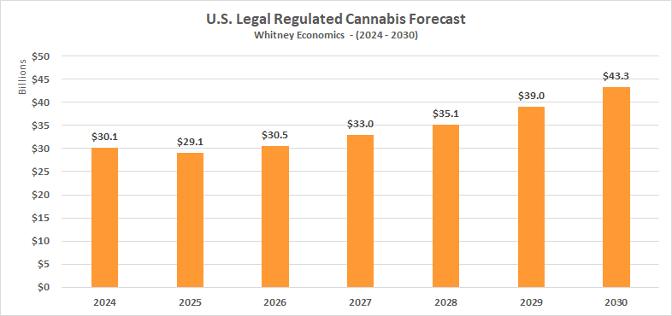
National legal cannabis retail sales reached $30.1 billion in 2024, up 4.5% from $28.8 billion in 2023, according to the Vangst/Whitney Economics Jobs Report 2025. That growth was driven primarily by emerging markets — New York, Ohio, Maryland, and New Jersey — as newer states ramped up their regulated programs. Mature markets like California, Colorado, and Illinois saw revenue soften, in part due to high tax rates and competition from unregulated products.
The market is forecast to reach $30.5 billion in 2026 and $43.3 billion by 2030, according to Whitney Economics projections. These figures include only regulated adult-use and medical sales — they do not count hemp-derived product sales.
PUBLIC REVENUE
$25 billion in state tax revenue since 2014
Cannabis excise taxes have become a meaningful and growing source of public revenue in legal states. In 2024 alone, adult-use cannabis generated more than $4.4 billion in state tax revenue — the most in a single year. States have directed these funds toward education, healthcare, drug treatment, infrastructure, housing, and community reinvestment.
$28.4B
$4.5B
$2.8B
7
Where the money goes
States have directed cannabis tax revenue to a wide range of public needs. Colorado directs the first $40 million in annual excise tax revenue to public school construction; additional revenue flows to the Public School Fund. Illinois directs 25% of cannabis tax revenue to the Restore, Reinvest, and Renew Program for economic development and violence prevention in communities harmed by the war on drugs. California allocates 60% of its discretionary cannabis tax fund to youth education, prevention, and treatment programs.
Arizona allocates roughly a third of its cannabis excise tax to community colleges, including about $28 million to the Maricopa County Community College District in the most recent fiscal year.
Importantly, the MPP figures above capture only state-level excise taxes from adult-use sales — they exclude medical cannabis tax revenue, local municipal cannabis taxes, business licensing fees, income taxes from industry workers, and federal taxes paid on cannabis business income. The actual total public revenue generated by legalization is considerably higher.
State Cannabis Tax Revenue — Selected States
Cumulative adult-use excise tax revenue since first legal sales ($ millions) · MPP 2025; state excise taxes only
EMPLOYMENT
425,000 jobs — and a decade of growth
The legal cannabis industry is one of the most significant job-creating sectors in the states where it operates. Since 2017, legal cannabis employment has grown by 246% — from 122,800 to 425,000 full-time equivalent positions. Even as the industry navigated headwinds in 2024, it remained a major employer across cultivation, manufacturing, retail, distribution, and ancillary services.
Cannabis Job Growth Since 2017
Full-time equivalent jobs in legal cannabis — U.S. · Vangst/Whitney Economics 2025; state-regulated markets only
Top states by cannabis employment (2024)
California leads all states with 74,623 cannabis jobs, followed by Michigan (45,000), Florida (30,968), Massachusetts (27,000), and Pennsylvania (25,000). Missouri and New Jersey both saw significant year-over-year job gains in 2024 as their markets continued to mature.
*Medical-only state. Source: Vangst/Whitney Economics Jobs Report 2025
| 1 | California | 74,623 | |
| 2 | Michigan | 45,000 | |
| 3 | Florida* | 30,968 | |
| 4 | Massachusetts | 27,000 | |
| 5 | Pennsylvania* | 25,000 | |
| 6 | Illinois | 22,500 | |
| 7 | Missouri | 22,353 | |
| 8 | Colorado | 21,363 | |
| 9 | Washington | 17,750 | |
| 10 | New Jersey | 15,000 |